
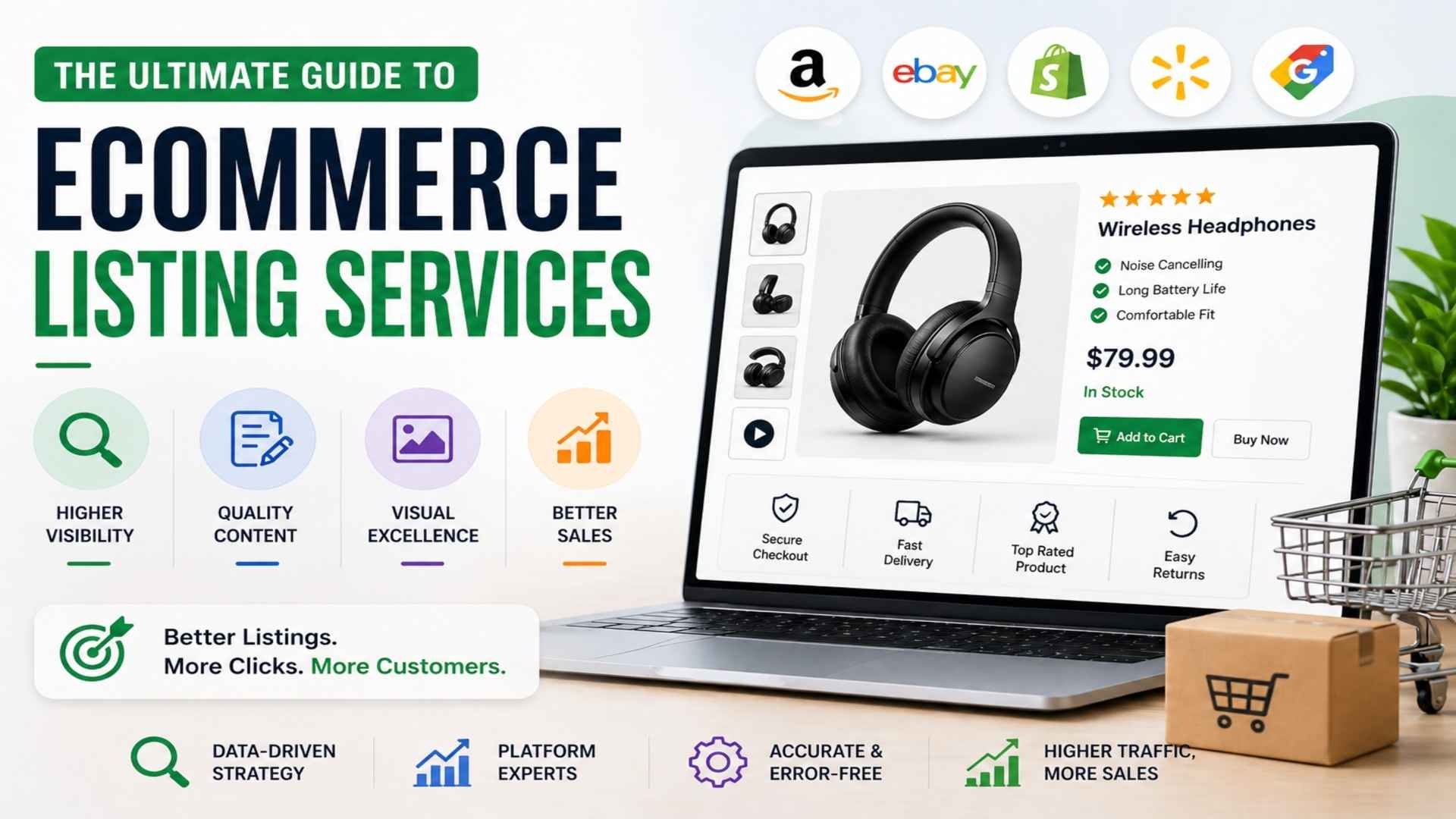
Your product listing is more than just a page in the variable pace of the global eCommerce universe; it encompasses three critical areas of business: it represents your first impression with consumers, it serves as a sales pitch to persuade consumers to buy, and it acts as the conversion machine that drives revenue when the sale is completed. Crafting your listings in a way to create an effective product listing on your eCommerce platforms (including your brand sites, Shopify stores, Amazon, eBay, etc.) is instrumental in determining whether or not your products are discovered or ignored.
This guide serves as a reference guide for understanding the full scope of E-commerce Product Listing Services. It explains the technical aspects associated with optimizing your listings and shows how using a professional manager can help grow your business in AI-driven environments.
What is an eCommerce Product Listing?
At its core, an eCommerce product listing is the dedicated landing page for an individual item. However, in modern retail, it serves as a data hub that feeds search engines, social media marketplaces, and price-comparison tools. A high-performing listing consists of several mission-critical elements:
- Strategic Product Title: The headline that must satisfy both human curiosity and algorithmic requirements.
- Visual Assets: High-resolution 4K imagery, 360-degree views, and cinematic explainer videos that replace the physical “touch and feel” experience.
- Persuasive Bullet Points: A prioritized list of features that translate technical specs into consumer benefits.
- Enhanced Product Descriptions: Rich text (such as Amazon A+ Content) that builds brand story and deepens consumer trust.
- Backend Metadata: Structured data and “hidden” keywords that allow search engines to categorize and index your product accurately.
The Strategic Role of Professional eCommerce Listing Services
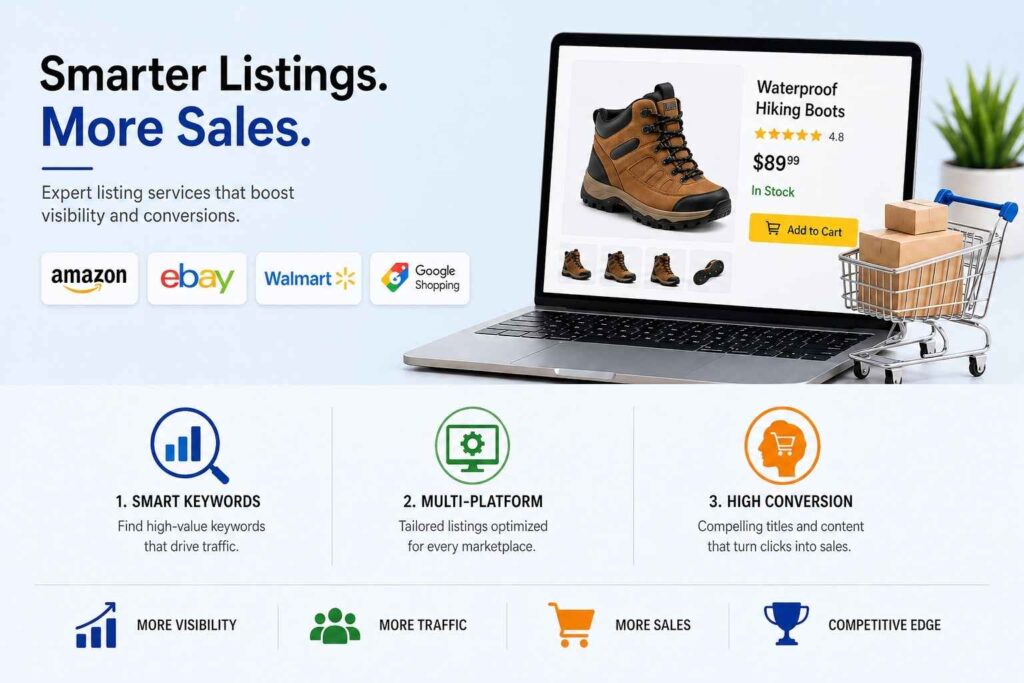
While a small business might start by manually uploading products, the complexity of maintaining a competitive edge grows exponentially with your catalog. Product listing services provide the technical, creative, and analytical expertise required to maintain high performance across multiple channels.
1. Data-Driven Keyword Research
SEO for e-commerce is fundamentally different from traditional content SEO. It focuses on “transactional intent,” identifying the specific terms a customer types when they have a credit card in hand. Professional services utilize advanced analytical tools to identify:
- Primary Keywords: High-volume terms that drive mass traffic.
- Long-Tail Keywords: Highly specific phrases (e.g., “waterproof leather hiking boots for men”) that often carry much higher conversion rates.
- Competitor Gap Analysis: Identifying keywords your competitors are ranking for and positioning your listing to capture that market share.
2. Multi-Platform Architectural Management
Every marketplace has its own unique “DNA.” A listing that ranks #1 on Amazon might fail on eBay or Walmart due to different algorithmic priorities. Professional services ensure your data is tailored to these nuances:
- Amazon: Focuses heavily on sales velocity and conversion-optimized Amazon A+ Content Services to enhance product storytelling and boost conversions.
- eBay: Prioritizes “Item Specifics” and detailed technical identifiers (MPN, GTIN).
- Google Shopping: Requires strict adherence to Merchant Center feed specifications and high-quality schema markup.
3. High-Conversion Copywriting & Psychological Triggering
Writing for eCommerce requires a balance between “writing for the bot” and “writing for the human.” Professional copywriters use psychological triggers—such as scarcity, social proof, and problem-solution frameworks to guide the user toward the “Add to Cart” button. They focus on the why rather than just the what.
Core Pillars of Product Listing Optimization (PLO)
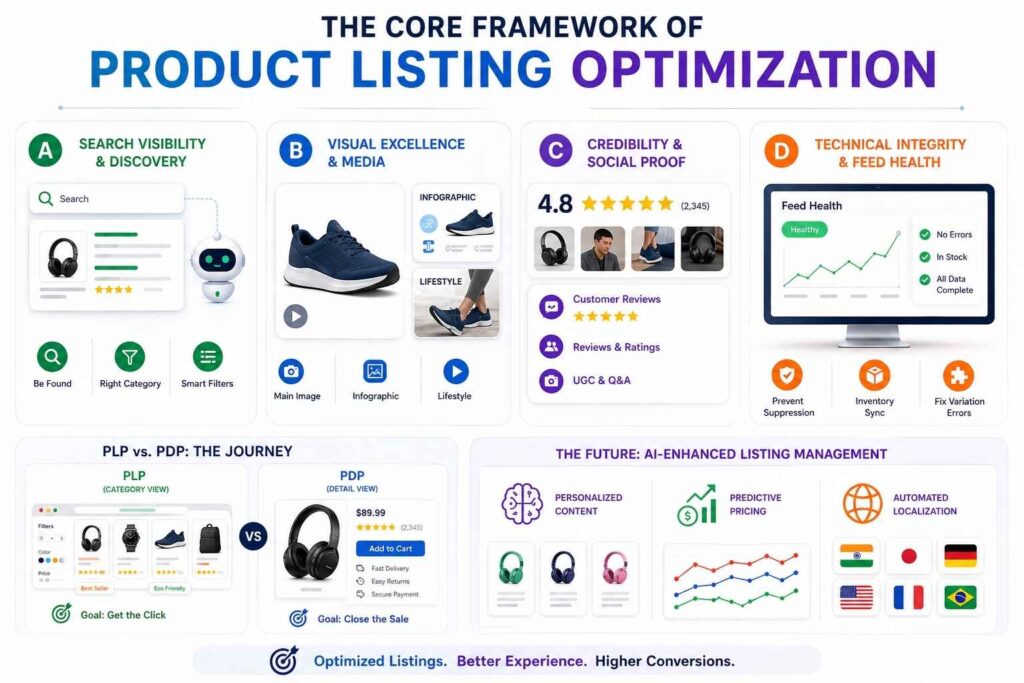
To dominate the digital shelf, your listings must be optimized across four distinct dimensions:
A. Search Visibility & Discovery
In 2026, visibility is no longer just about keywords; it is about Answer Engine Optimization (AEO). With AI assistants like Gemini and ChatGPT helping users shop via voice and text, your listings must use structured data (Schema) to be “readable” by AI agents.
- Title Front-Loading: Placing the most important brand and feature keywords in the first 60–80 characters to ensure they aren’t truncated on mobile devices.
- Browse Node Optimization: Ensuring your product is categorized correctly so it appears when users apply filters (e.g., color, price range, material).
B. Visual Excellence and Media Integration
Visuals are the primary driver of engagement. Research shows that listings with video content can increase conversion rates by up to 80%.
- The “Main Image” Standard: Must be a high-resolution (min. 2000px) shot on a pure white background to meet marketplace compliance.
- Infographic Slides: Instead of expecting customers to read the description, top-tier listings use images with text overlays to highlight key selling points quickly.
- Lifestyle Context: Showing the product in a real-world setting helps the customer visualize ownership and understand scale.
C. Credibility and Social Proof
Shoppers are naturally risk-averse. Professional listing management includes active monitoring of customer reviews and Q&A sections. Integrating User-Generated Content (UGC)—such as customer-uploaded photos—adds a layer of authenticity that studio photography cannot replicate.
D. Technical Integrity & Feed Health
A “broken” listing is a dead listing. Technical services monitor your “Feed Health” to prevent:
- Listing Suppression: When a marketplace hides your product due to missing data or policy violations.
- Inventory Desync: Preventing “Out of Stock” status, which can devastate your search rankings.
- Variation Errors: Ensuring that sizes, colors, and styles are correctly grouped so that reviews and rankings are aggregated.
PLP vs. PDP: Navigating the Customer Journey
A comprehensive eCommerce strategy distinguishes between the Product Listing Page (PLP) and the Product Detail Page (PDP).
- The PLP (The Category View): This is the “aisle” of the store. Optimization here focuses on being found. It involves mastering filters, badges (like “Best Seller” or “Climate Pledge Friendly”), and competitive pricing to win the “click.”
- The PDP (The Decision View): This is the individual product page where the sale is closed. Every element here—from the shipping transparency to the FAQs—must work together to remove friction and overcome buyer objections.
The Future: AI-Enhanced Listing Management
The industry is moving toward “Dynamic Listings.” In the near future, eCommerce product listing services will leverage AI to:
- Personalize Content: Showing different images or descriptions to different users based on their past shopping behavior.
- Predictive Pricing: Adjusting prices in real-time based on competitor stock levels and market demand.
- Automated Localization: Instantly translating and culturally adapting listings for international marketplaces like Flipkart or Rakuten.
Conclusion
In today’s online retail world, we can safely say that having a “good enough” product to sell doesn’t cut it anymore. With more products occupying the digital shelf, your data quality, visual clarity, and SEO will ultimately determine how successful you are on the Internet.
When you invest in professional eCommerce product listing services, you do so from a strategic perspective. You are not simply incurring an operational expense; you are making a significant investment in your brand’s future. High-quality optimization ensures that your products are discoverable; customers find them, trust them, and purchase them.
Leave a Reply