
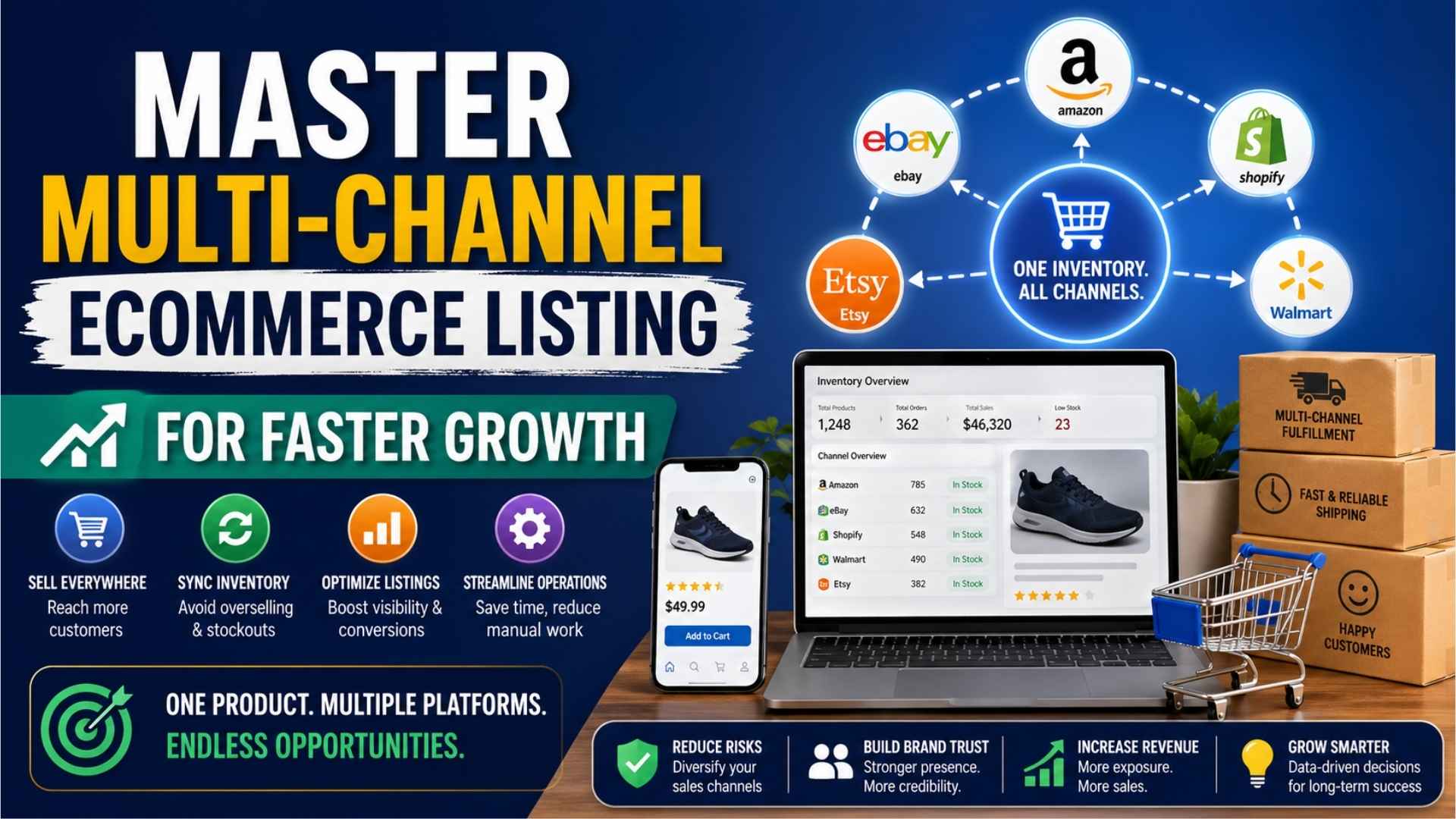
Today’s consumers don’t just shop at one place. In order to get their business, retailers must sell on multiple platforms – whether that’s on Amazon, eBay, or a specialty Shopify Store. As your business grows into a full-blown, multi-marketplace brand, it is important to transition from single-channel sales to selling on multiple channels simultaneously.
While the concept of being everywhere (or having a strong brand presence) seems simple enough, executing this will prove more challenging. Once you have decided which platforms you want to sell on, how can you ensure that you are consistently providing customers with the same experience across all channels? How do you prevent selling products that you don’t actually have in stock? How do you leverage your inventory so that you can maximize your visibility on each channel? These are just a few of the questions that need to be answered as you implement E-commerce product listing services into your strategic plan for success in multi-channel retailing.
Why Multi-Channel Selling is the New Industry Standard
Recent data suggests that retailers who sell on three or more channels generate significantly more revenue than those sticking to a single storefront. But the benefits extend beyond just the bottom line:
- Risk Diversification: Relying on one platform leaves you vulnerable to algorithm changes or account suspensions. Multiple channels act as an insurance policy for your income.
- Brand Credibility: When a customer sees your product on Amazon, Etsy, and your own professional site, it reinforces brand authority and trust.
- Audience Expansion: Different platforms attract different demographics. While Amazon is the king of “intent-based” buying, platforms like TikTok Shop or Instagram are driving the discovery-based commerce revolution.
How to List on Multiple Platforms: A Step-by-Step Framework
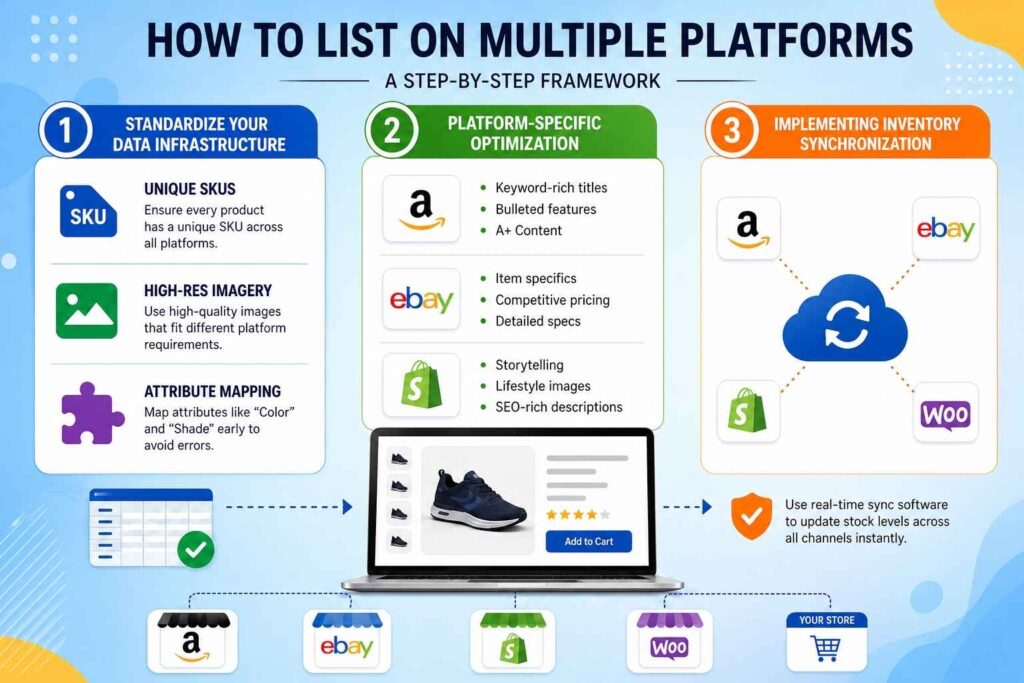
Transitioning to a multi-channel model requires more than just “copy-pasting” your descriptions. Each marketplace is a unique ecosystem with its own rules, technical requirements, and customer expectations.
1. Standardize Your Data Infrastructure
Before you post items for sale on multiple sites, you need a “Single Source of Truth.” This is usually a Master Spreadsheet or a Product Information Management (PIM) system.
- Unique SKUs: Ensure every product has a unique Stock Keeping Unit (SKU) that remains identical across all platforms.
- High-Res Imagery: Maintain a library of high-quality, professional images (4K resolution is the current standard) that can be cropped or formatted for different site requirements.
- Attribute Mapping: Every site has different names for the same thing (e.g., “Color” vs. “Shade”). Map these out early to avoid upload errors.
2. Platform-Specific Optimization
A common mistake is using the same listing for every site. To rank higher, you must tailor your content:
- Amazon: Focus on keyword-dense titles, bulleted features, and A+ Content. Amazon’s A9 algorithm rewards conversion rates and sales velocity.
- eBay: Prioritize item specifics and competitive pricing. eBay’s Cassini search engine favors sellers with high feedback and detailed technical specifications.
- Shopify/DTC: Use storytelling, lifestyle photography, and SEO-rich long-form descriptions to build a brand narrative that marketplaces often strip away.
3. Implementing Inventory Synchronization
Nothing kills a brand’s reputation faster than “overselling.” If you have one item left and it sells on eBay, but your Amazon listing stays active, you’re headed for a cancellation and a hit to your seller rating. Pro Tip: Use real-time sync software that updates stock levels across all channels within seconds of a sale.
The Logistics of Selling on Multiple Marketplaces
Managing the “back end” is where most sellers struggle. Effective e-commerce product listing services take these operational hurdles into account to ensure a smooth customer experience.
Centralized Order Management
Instead of logging into five different dashboards, successful sellers use a unified interface. This allows your team to:
- View all incoming orders in one place.
- Print shipping labels for different carriers from a single screen.
- Manage customer inquiries and returns without switching tabs.
Unified Fulfillment Strategies
Will you use Fulfillment by Amazon (FBA) for all orders, or a mix of Third-Party Logistics (3PL) and in-house shipping? For multi-platform success, many sellers adopt “Multi-Channel Fulfillment” (MCF). This allows Amazon to ship orders placed on Shopify or eBay, ensuring fast delivery across the board while simplifying your stock levels.
Advanced Tactics: Posting Items for Sale on Multiple Sites
To truly master selling on multiple platforms, you must look beyond the basic upload. You need a strategy for growth and maintenance.
The “Duplicate Content” Myth
Many sellers worry that having the same product on multiple sites will hurt their Google SEO. In reality, Google understands the difference between a marketplace listing and a blog post. However, slightly varying your descriptions for each site helps you capture a wider range of long-tail keywords and prevents “cannibalization” of your own search results.
Navigating Varied Fee Structures
Not all sales are created equal. A product that is highly profitable on your own Shopify store (where you keep most of the margin) might be a “loss leader” on Amazon after referral and fulfillment fees.
- Strategy: Calculate your “Channel Contribution Margin” for every platform to see where your marketing dollars are best spent. Adjust your pricing dynamically if the platform allows it.
The Role of Keyword Research
When you list items on multiple sites, your keyword strategy must shift. On Amazon, people search for “waterproof running shoes.” On Etsy, they might search for “hand-crafted athletic footwear.” Using professional keyword research tools for each specific platform is a hallmark of high-tier ecommerce product listing services.
Common Pitfalls to Avoid in Multi-Channel eCommerce
Even seasoned veterans make mistakes when expanding. Avoid these three common traps:
- Ignoring Customer Service: Each platform has different SLAs (Service Level Agreements). Amazon expects a 24-hour response time. If you ignore one channel while focusing on another, your account health will suffer.
- Inconsistent Branding: Your logo, tone of voice, and brand promise should be identical whether a customer finds you on Walmart or your own site. Inconsistency breeds distrust.
- Manual Data Entry: Trying to manually update 50 products across 4 sites is a recipe for typos and errors. Use automation wherever possible.
Choosing the Right eCommerce Product Listing Services
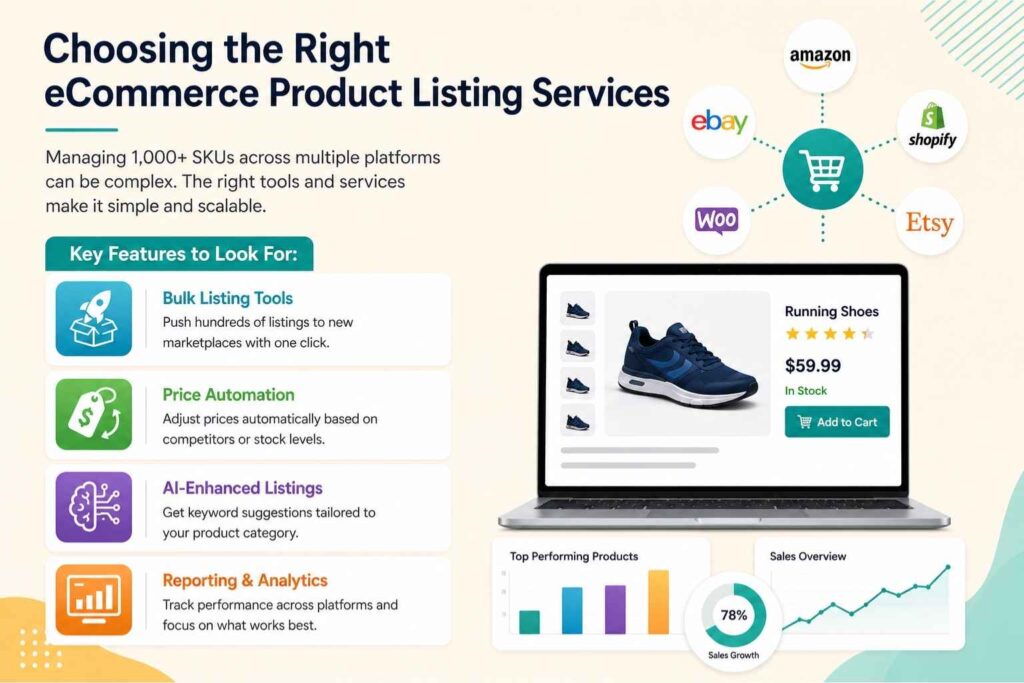
If managing 1,000+ SKUs across five platforms sounds daunting, you’re right—it is. This is where professional services and software integration become essential.
Key Features to Look For:
- Bulk Listing Tools: The ability to push hundreds of listings to new marketplaces with one click.
- Price Automation: Dynamic repricing tools that adjust your eBay or Amazon prices based on competitors or stock levels.
- AI-Enhanced Listings: Tools that use data-driven insights to suggest the best keywords for your specific product category.
- Reporting and Analytics: A dashboard that shows you which products are performing best on which platforms, allowing you to double down on what works.
Future-Proofing Your Multi-Channel Strategy
As we move further into the decade, the integration of AI and realistic UI visualizations is changing how customers interact with listings. Sellers are now using holographic UI elements in their videos and interactive 3D models to reduce return rates.
Furthermore, the rise of Social Commerce means that “listing” now includes setting up shops on platforms like TikTok, Pinterest, and even YouTube. The goal is no longer just selling on multiple platforms—it’s creating a seamless, “omnichannel” experience where the customer journey is frictionless, regardless of where it begins.
Conclusion
The key to successful sales across several channels doesn’t begin with launching on ten different sites at one time. Instead, begin with your main sales channel. Refine listing optimization for that particular channel first. After that, focus on adding each of your subsequent sales channels in an orderly fashion based upon relevance to your business. Once you have used professional e-commerce product listing services and maintained a strict adherence to data consistency and inventory synchronisation, the single-product retailer can become a multi-channel retailer and thrive in the highly competitive e-commerce marketplace of 2026. This marketplace is for those who can be flexible. Concentrate on your data and optimise that data for each channel you sell on. By doing this, you can successfully grow your business and become known throughout the online marketplace.
Leave a Reply